themisim
Similarity search over THEMIS all-sky
imager (ASI) auroral imagery. A SimCLR-trained ResNet-18 encoder turns each
256×256 frame into a 512-D feature vector whose cosine proximity tracks visual
and morphological similarity rather than pixel-level identity; those vectors are
indexed with FAISS (OPQ-IVF-PQ). Given any indexed frame, themisim returns
the most visually similar frames across the archive.
Architecture
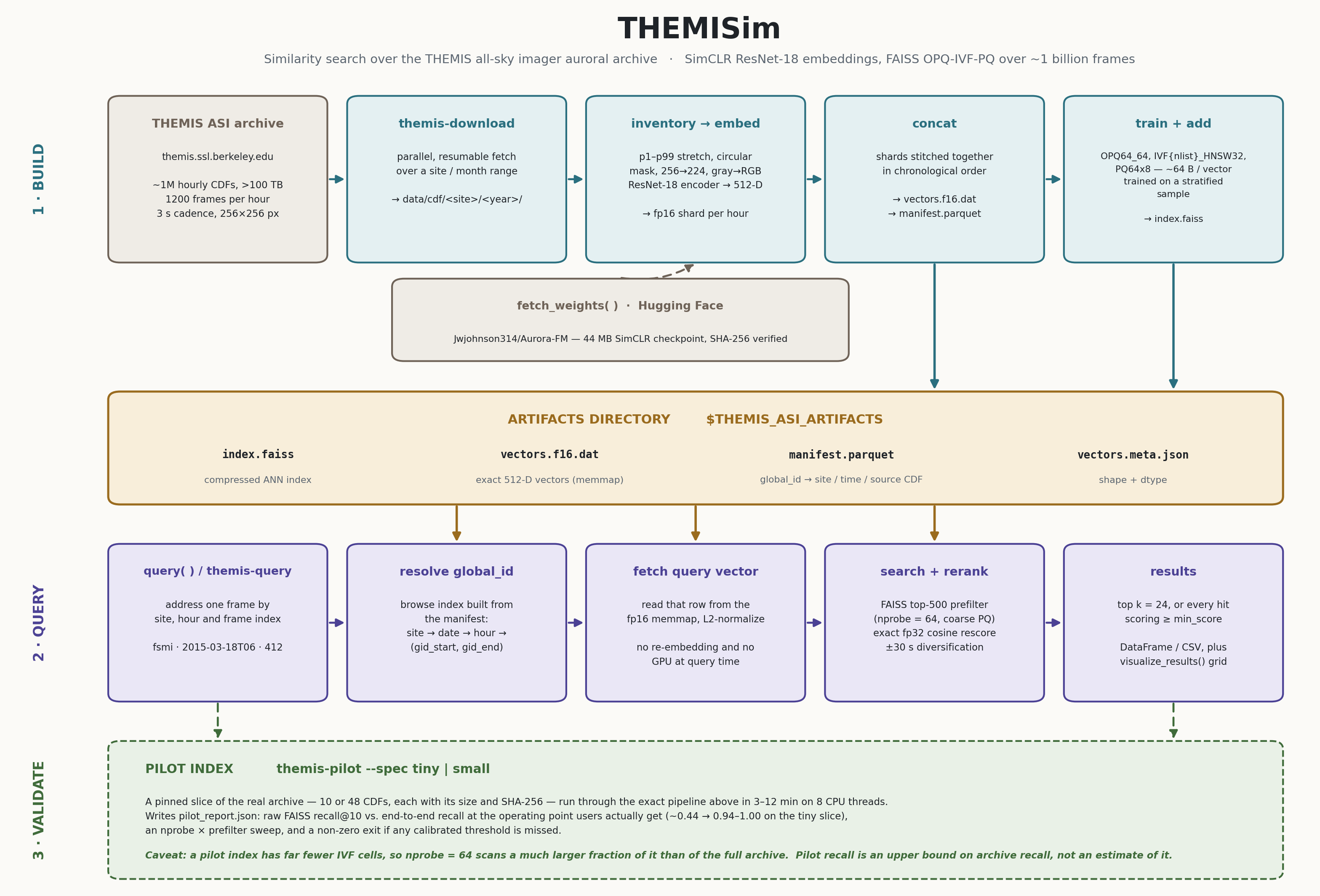
Build embeds every 256×256 frame through the SimCLR encoder into a 512-D
vector, stitches the per-hour fp16 shards into one memmap in chronological
order, and trains an OPQ64_64,IVF{nlist}_HNSW32,PQ64x8 index on a stratified
sample — about 64 bytes per compressed vector.
Artifacts are the four files every query needs. Because global_id is the
memmap row index and shards are concatenated in site-then-time order, each site
occupies one contiguous block, which is the property the filtered-query fast
path relies on.
Query addresses a frame by (site, hour, frame) and reads its stored
vector straight from the memmap — nothing is re-embedded and no GPU is needed —
then pulls a coarse candidate pool from the compressed index and rescores it
exactly in fp32. The approximate step decides what can be found; the exact
step decides the order. See Performance.
Validate is the pilot path, described in Pilot indexes. Note the caveat on
the diagram: a pilot index has far fewer IVF cells, so the same nprobe scans
a much larger fraction of it, and pilot recall is an upper bound on archive
recall rather than an estimate of it.
Contents
Installation
pip install themisim
faiss-cpu is pulled in automatically (the query path is CPU-only). A
CUDA-enabled PyTorch speeds up index building but is optional — every stage
falls back to CPU.